 CramNotes
For the night before a test
Have a test tomorrow. Learn the topic tonight.
Type the topic, paste your notes if you have them, and get short study segments you can actually finish. Then compress the highest-yield facts onto a one-page study sheet.
By the time you close the laptop, you should be able to
- Break any topic into 5 to 10 minute segments
- See why each piece shows up on tests
- Check yourself before you move on
- Pack a one-page sheet of formulas, dates, and definitions
- Use your own class notes as the source
A real cram
Cellular respiration
How cells turn glucose into ATP. Five segments: the goal, glycolysis, mitochondria, the Krebs cycle, then the electron transport chain.
About 40 minutes
- 01
Why cells bother
6 minRespiration is not breathing. It is the set of reactions that pull energy out of glucose and store it as ATP.
- 02
Glycolysis
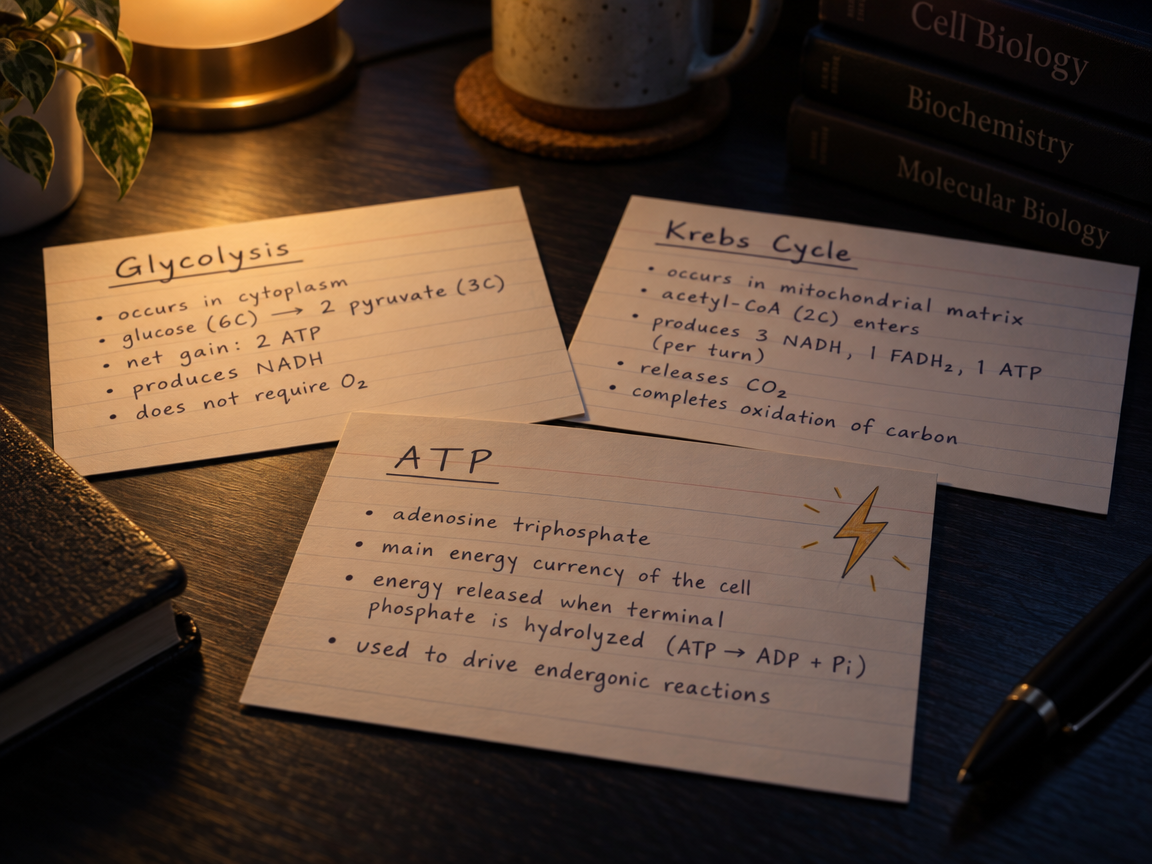
8 minIn the cytoplasm, glucose splits into two pyruvate. Net 2 ATP and NADH. No oxygen needed.
- 03
Into the mitochondria
7 minPyruvate becomes acetyl-CoA. Carbon dioxide starts coming off. This is the door into the Krebs cycle.
- 04
Krebs cycle
8 minEach turn of the cycle finishes oxidizing carbon and loads NADH and FADH2. Tests love the counts per glucose.
- 05
Electron transport
9 minThose carriers dump electrons to oxygen. The proton gradient runs ATP synthase. This is where most ATP is made.
Then pack the page
What fits on one allowed-notes sheet
Formulas, counts, and the few facts that earn points. Leave the stories off. Copy it by hand so it sticks.
Cellular respiration
Glycolysis
- Cytoplasm, no O2
- Glucose to 2 pyruvate
- Net 2 ATP + 2 NADH
Krebs cycle
- Acetyl-CoA in
- CO2 comes off
- NADH and FADH2 loaded
ETC
- O2 is the last acceptor
- Proton gradient
- ATP synthase makes most ATP
Counts to know
- About 30 to 32 ATP per glucose
- 6 CO2
- Where each step happens

The test is at 8am. You still have tonight.
What you get
Cram app
The tool that turns a topic into tonight's plan.
Study hall
A forum for topics other students can reuse.
Cram chat
Quick questions when a segment will not stick.
How to cram
Three short lessons so you do not waste the night.
Risk-free guarantee
7-day no-questions-asked refund
If CramNotes does not save you time or help you learn your exam topic tonight, you are completely covered. Request a refund within 7 days, no questions asked.
Monthly
$9.99per month
- Unlimited cram sessions
- Study sheet builder
- Study hall, chat, and the how-to course
Semester
$24.99one payment, 120 days
- Same tools as monthly
- Covers a full term
- Does not auto-renew
Questions
Is this for cheating?
No. The study sheet is for classes that allow a page of notes. It compresses what you should write down. It will not write hidden answers for a closed-book exam.
Do I need my own notes?
No. A topic is enough to get a standard crash course. If you paste notes or research, those become the source of truth.
How long does a cram take?
Most topics land in 4 to 6 segments, about 30 to 50 minutes if you actually work through the checks.
What if I only need it this term?
Take the semester pass. It lasts 120 days and does not renew.